Guide
This guide covers how to use Romp and how its back end works.
The Romp user interface
Romp gathers all your Claude Code sessions into one interface, with five complementary views of what the agents are doing:
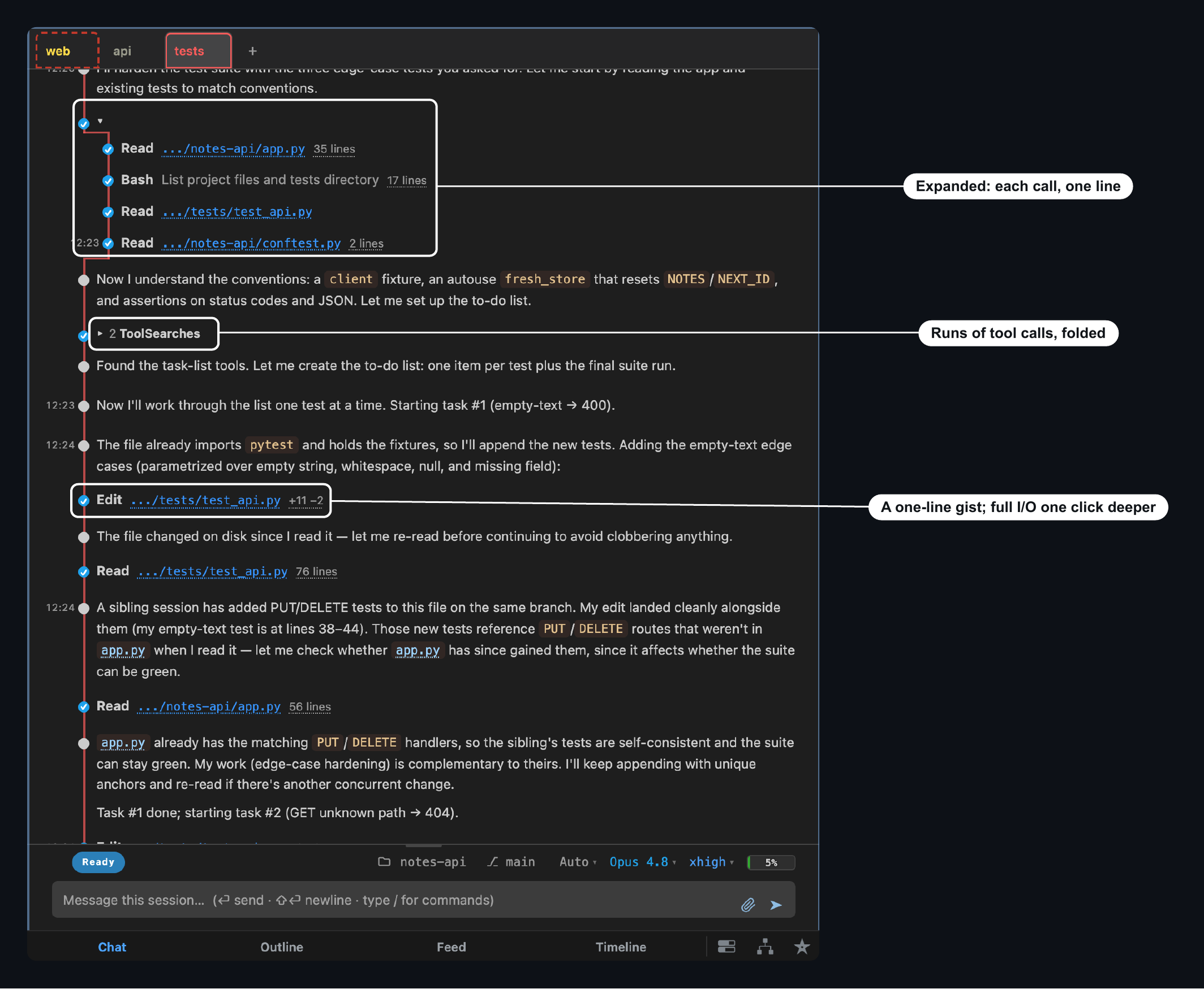
- The chat is the regular interface for talking to a coding agent, with features that make a long session easier to scan.
- The feed is Romp's task-management layer: what is in progress, what needs your input, and what is done.
- The timeline is the history of what each session worked on and how they coordinated; click any part to jump to that moment in the chat.
- The outline lists every session with its tasks, for reviewing what a session has done and searching across all of them.
- Files holds the file viewer in a column of its own, so a file stays open beside the chat and the feed. Off by default.
The chat
Dropping a file. Drop an image or any file anywhere on the chat pane and it attaches to the message box of the session you are looking at; a dashed ring shows the pane is the target while you drag, and in a split each column takes its own drops. Dropped anywhere else on the dashboard, a file is refused (the cursor says so) rather than opened in place of the page.
Reviewing a document. Select any passage in the file viewer and it lands in the
composer as a quote chip, labeled with the file and the line the passage lives on. Type
what should change and press ⌘⏎ to set the note aside; keep reading, select the next
passage, and repeat — each staged note remembers its quote and its place. The list above
the composer shows about four staged notes and scrolls for the rest; its caret collapses
it to the count. ⏎ sends everything you staged along with whatever is in the box as
one message, so the session applies the lot in one pass, and you never copy a line out of
the document by hand. The line in each label is checked against the file at the moment
you select, so numbers that moved under you are caught rather than quietly carried. When
several sessions work in the same repository, or in worktrees of it, the viewer's title
bar says which one you opened the file from: a chip with the session's name, in the same
color as its tab. The title bar's GitHub ↗ button opens the file on GitHub. While the
check runs, the button waits dimmed with pulsing dots beside it.
When there is nothing to open, the button stays in place, dimmed, and a caption beside it
says why (the file is not in a git repository or not committed — untracked, staged but in no
commit, or on a branch with no commits yet — the repository has no origin remote, its origin
is not on GitHub, or the path is relative and no session's directory resolves it); the
button's tooltip repeats the reason. A file on a branch that is not on origin keeps its link,
drawn with a dashed border, and the caption says the branch is not on origin yet. That check
trusts your clone's own refs: a branch deleted on GitHub reads as present until git fetch
--prune, and one pushed from another clone reads as absent until a fetch. A branch that has
never been pushed is asked of origin once and the answer kept until a push or fetch from this
clone writes its tracking ref; where nothing local could refresh the answer (a
--single-branch clone, or a branch on origin this clone has not fetched) origin is asked on
each open.
A pull request number in a message, a card, or a note (#123, PR #123, or
owner/repo#123) links to that pull request on GitHub, in the repository the session's
directory has as its origin remote; when that remote is not on GitHub, the number stays
plain text.
Naming another session. Type @ and the first letters of a session's name in the
message box, and the sessions whose names match are listed above it, twelve at most; when
more match, the last row says how many, and more letters narrow the list. Arrow to one and
press ⏎ or Tab, or click it, and @name goes into the message as plain text, the
name the session's mail tools take. Which form goes in depends on the session you are
writing to. When you write to a session on this machine, a session on another machine goes
in as @host:name, the way this machine knows it. When you write to a session on another
machine, every name goes in bare, because the dashboard cannot see what that machine calls
its peers; if the bare name is ambiguous there, the session's mail tools refuse the send and
list the candidates as host:name, and the session picks one. Escape closes the list
without inserting, and it stays closed for that @ until you delete it: more letters, or a
caret move away and back, do not reopen it. In the sent message, a name that matches a live
session is shown as a chip: the name without its @, in that session's color on a dark
backing, the way the Awaiting chip names the session it waits on. Hover it for how that
session is doing; the message itself still carries the @name you typed, and so does a
copy of it.
A message that has not gone yet. Send to a busy session and your message waits as a dashed bubble under an hourglass until the session takes it — while it compacts, while a turn runs, or in the beat before the kernel confirms the send. Until then it is still yours: the ✎ in its corner takes it out of the queue and puts it back into the message box — the words, the quote chips it was written against and its attachments — so you can change it and send it again, or clear the box to drop it. A queued slash command, and a notice romp itself queued, carry a ✕ instead: there is nothing to reword, so they just cancel. If the session took the message before you pressed, the bubble says so and the box is left as it was, so nothing is sent twice. One narrow window: a chat page from before an update, still open while the kernel restarts on the new one, presses a pencil the new kernel no longer knows as an edit; the bubble reverts and the message stays queued. The page reloads itself on the new kernel within moments, which keeps that window short.
Opening a markdown document. A markdown link in the chat opens in the file viewer,
rendered, with Raw one click away — a path on the session's machine, or a link to a
file served from the dashboard's own address (a published report, an evidence doc). Figures
and links inside the document resolve relative to the document, so a 
beside it shows, and a link to a sibling document opens in the same viewer. Links to files
on other sites open in a new tab, as before — and a ctrl- or ⌘-click still opens the file in
a tab. The document is set for reading: a sans face at a slightly larger size, headings in
proportion, a centred column about 80 characters wide, and task lists, keyboard keys and
aligned table columns as GitHub shows them. Every code block is numbered by line and carries a
Copy button that copies the block as the file holds it, tabs included; fences labelled
rust, go, c, java, sql or toml are highlighted, in addition to the languages the
chat already knows. Printing the page while a rendered file is open prints the file alone,
black on white, across as many pages as it needs.
A file's own HTML. The Rendered view keeps the HTML a markdown file carries, under rules
modelled on those GitHub applies to a README, so nothing in a file can move, hide or cover the
viewer's own controls. A <style> block is dropped whole. A form, its controls and a
<dialog> are dropped but their text stays as prose. A task-list checkbox stays but cannot be
ticked. An inline style keeps only its color and background-color, and only when the
value is a color name, a hex code, or rgb(), rgba(), hsl() or hsla(); a span colored
with any other function, such as var(), loses its color. A background= attribute is
dropped, since it would load a remote image the moment the file opens. An inline svg, a
canvas or a video shrinks to the column, as a picture does, and a table wider than the
column scrolls sideways on its own. An element's id or name is prefixed user-content-,
as on GitHub; the viewer's own heading ids are not, so a link to a heading in the file still
lands on it. An image map (<map>, usemap) is dropped. The same rules apply to the HTML in
a chat message, where a link to an element's own id or <a name> lands on it under the
prefix.
Text size and width. The A− and A+ buttons in the viewer's title bar make the text of any text file smaller or larger in fixed steps from 70% to 200%: a markdown file's Rendered and Raw views, the code view of every other text file, and a document opened from a link on the dashboard's own address. They appear wherever the viewer opens (over the chat or the feed), and not for a picture or a PDF, which have no text to size. Ctrl (or Cmd) and the mouse wheel over the text do the same. Once the size is off 100%, the percentage appears between the buttons; click it to go back. The choice is kept in this browser and applies to every file you open here. Prose keeps a readable line length that grows with the text size, and code blocks keep that width and wrap long lines. A table is as wide as its columns need, up to the width of the viewer, and scrolls sideways on its own beyond that; a table inside a quote or a list item stays within the prose width. Pictures shrink to fit, so the page is never wider than the viewer.
Opening a PDF. A PDF the session mentions, or one you click in the file browser, opens inside the dashboard like an image: the chat's PDF card opens it full-view, a path or a file-browser row opens it in the file viewer. Cmd-click it instead (Ctrl on Windows and Linux), or middle-click, and it opens in a new browser tab in the browser's own viewer, the way a paper opens from OpenReview: full size, and it stays open beside the dashboard while you keep working. If the browser blocks that new tab, the PDF opens inside the dashboard instead; a PDF too large to show offers a download in its place.
Links in a file. Wherever the viewer shows a file's text, the links in that text work. A
web address opens in a new browser tab. A file path opens that file in the viewer, in place of
the one you were reading: a relative path such as docs/guide.md is taken from the folder of
the file you are reading, an absolute or ~/ path as written, on the machine of the session the
file belongs to, and a line written after the path (src/app.py:12, or src/app.py#L12)
scrolls the code view to that line. A Markdown file opens in its Raw view for that one open, since
the Rendered view has no lines; your Raw/Rendered choice is unchanged. A line past the end of the
file lands on the last line, with a notice saying so. In a Markdown file, a [link](target)
follows the same two rules: a web target opens a tab, a file target opens the file (a host with a
port, 127.0.0.1:3000 or api.example.com:8443, is neither, and says so). A link to a section
of another file (report.md#results) opens that file at the section. A link to a section of the
same document scrolls to it when the document has a heading or an anchor by that name
(<a name="install"> included), and otherwise says so when you hover it; it scrolls under every
click, since a section of the shown file has no tab of its own. One click does one thing: a plain
click acts in the dashboard, and a Cmd-click (Ctrl on Windows and Linux) or a middle-click opens
the link in a browser tab of its own. Inside a file the test for a path is stricter than the one
a chat message's prose gets, and a fenced code block in a chat message follows the file's test
too, linking a path only once the kernel has verified it is a file: a path links only when it has a slash and a file extension, starts on its
own, at the start of a line or after a space, a quote, a bracket, a comma, a semicolon, an
equals sign, a pipe or Markdown's * (so $HOME/docs/a.md, @scope/pkg/index.js and
C:/Users/x.txt stay text), is not part of a web address, does not start with a site name
(www.example.org/docs/index.html), and is not the package an import statement or a
require() call names, whether the statement fits one line or its from starts the next (a
relative import such as ./app.css still links, and so does a path after the English word
"from" in prose, unless that line holds nothing but from and the
quoted path). After a * the path must be the whole emphasised text, closed by a * of its
own: *docs/a.md* and **./scripts/setup.sh** link; a glob's **/docs/a.md, an operand's
w*h/img.size and the first path in **docs/a.md and docs/b.md** stay text. Web addresses and
paths found in the text wear a dotted underline that turns solid under the pointer; a Markdown
link that names a file keeps the ordinary link look. Selecting text across a link works as
before, and a click that lands while text is selected inside a link opens nothing.
A session that needs you. A tab wears a dashed red ring while its session is stopped on a permission or picker prompt. When the feed shows one of the session's cards under Blocked (it asked you something, it is waiting on a decision, a peer's message is waiting for your say, or a stalled task needs a look), the tab wears a dashed yellow ring instead, whether the session is idle, waiting on background work or still working, so the sessions that need you stand out in the strip without a click through each of them; a working session keeps its gold dot inside the ring. The ring follows the feed, one refresh behind it at most, and goes when the card does: answer it, resolve it or clear it and the tab is plain again. A red ring outranks the yellow one; the amber ring of a session retrying an API error on its own gives way to it. The three rings are rows of Settings, Chat, Tab widgets (Needs you, Waiting on you, Retrying), each with its own switch, listed in that order because a tab wears one ring at a time and the first that applies wins: red over yellow over amber. A ring switched off leaves the tab with its dot; the small dot on a folded group's header and the phone's picker follow the same switches. With notifications on, the card entering Blocked is also what notifies you (see Notifications on your phone): the ring is that card, shown in the strip, and it stays as long as the card does, including across a kernel restart, which announces nothing. On a phone, the session picker marks the same sessions with a yellow bar at the row's left edge, and the button that names the current session wears the dashed yellow border.
Tags and groups. A tag is a named, colored set of sessions; a session can be in
several. Right-click a tab and open Tags to add or remove them. Tags filter every
surface (the tag button in the strip narrows the tabs to the tags you pick), and they group
the tabs: as soon as any session carries a tag, the strip shows one section per tag, in your
tag order, each with a header in the tag's color, and the untagged sessions on a row of their
own at the end. A session with several tags appears under each of them; every copy is the same
session (click either to open it, and closing either ends it). Each header shows the tag's color and name, then a chevron and a
member count. Click a header, or press Enter on it, to fold its section down to the header
alone; the count then says how many tabs are folded away, and a small dot after it shows when
one of them is busy or needs you: red when one is blocked or waiting on you, otherwise yellow
when one has something waiting on you, otherwise gold when one is working, otherwise amber
when one hit an API error and is retrying on its own (hover it for their names). To keep one tab visible while its section is folded, right-click
the tab and pick Show when folded under Tags;
the header's count then leaves that tab out; when every tab in a section is set to
show, the folded header shows the full count and its tooltip says nothing is hidden. Pick it
again to fold the tab with the rest. A tab set to show when folded keeps that setting when its
group is renamed. The section of the tab you are reading folds like any other; its header marks
that it holds the tab (the tag's name is underlined), and folded, the header stands in for the tab:
focus lands on it, and the left and right arrows step from there. The archived section starts
folded. Drag a header to reorder the groups, which
reorders the tags on every surface (the timeline's tag table shows the same order). To move
a tab into another group, right-click it and pick Move to
A section at a glance. Clicking a header also shows the section in the transcript's place: one row per session, with its color, a dot for its state (yellow working, red stopped on a prompt or an API error only you can clear, amber retrying an API error on its own, teal compacting, green waiting on background work, none while it is idle), a state chip when the state is worth a word, what it is doing now in a few words, and how long ago it last did anything. The chip is the one the bar under the transcript wears for the session you are reading, with the same words and colours: Blocked when the feed shows one of the session's cards under Blocked or the session is stopped on a prompt (API error when it is stopped on one only you can clear), and Awaiting with what is awaited (Awaiting 3 agents, Awaiting watch, the peer's name) when it is waiting on background work. A session that asked a question and went quiet shows the chip with no dot: the dot follows the session's own state, the chip follows the feed. What it is doing now comes from its current task, else from the headline of its work so far, else from the last task it had; a session that has published a note of what it is working on shows the note as a quieter second line. Hover a row for its last message, shown without its formatting; click one to open that session, which also opens its section if the section is folded (with several tags, the first folded group of them). The rows update as the sessions work and change only when something about a session changes; the Blocked chip follows the feed, one refresh behind it at most. The transcript comes back when you pick a session, press Escape, or click that header again while its section is open and holds the tab you are reading.
Coming back after a dropped connection. When the dashboard's link to the kernel drops and comes back (a laptop lid closed and opened, a network change, a phone that slept), the page does not fetch every session again. The kernel sends the session you were reading in full and lists the others as skeleton tabs: the strip is complete at once, each tab with its name, color and status, and a transcript arrives only when it is wanted. Click a skeleton tab and the romp loader stands in until its transcript lands; the tabs you do not click fill in one at a time while the page is idle, never while the browser tab is hidden. Until then a skeleton tab's hover tooltip says it is not loaded yet.
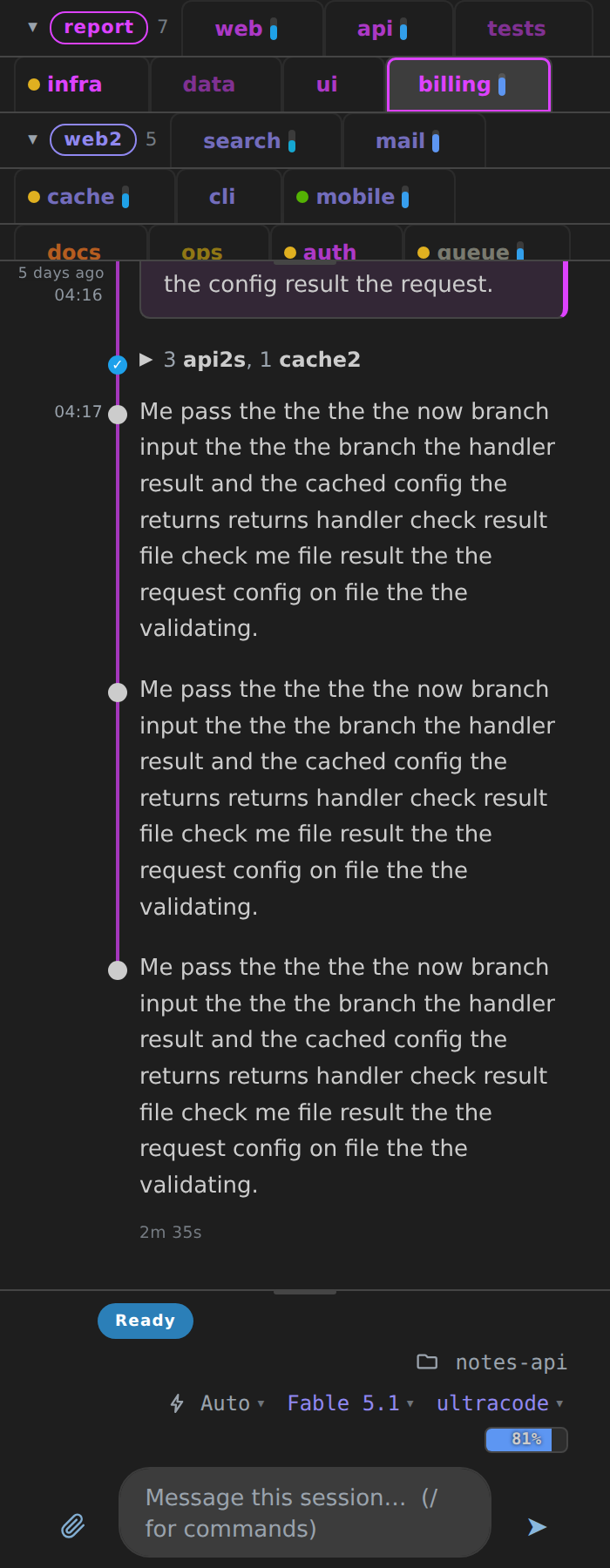
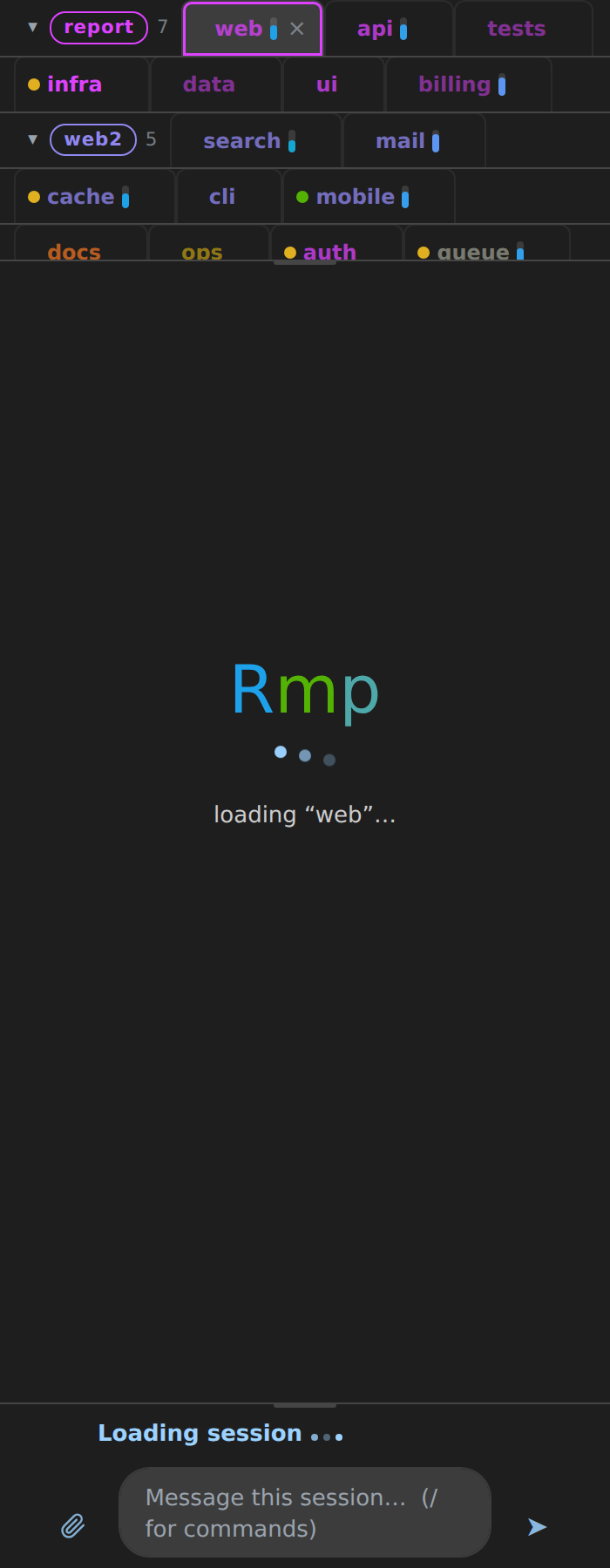
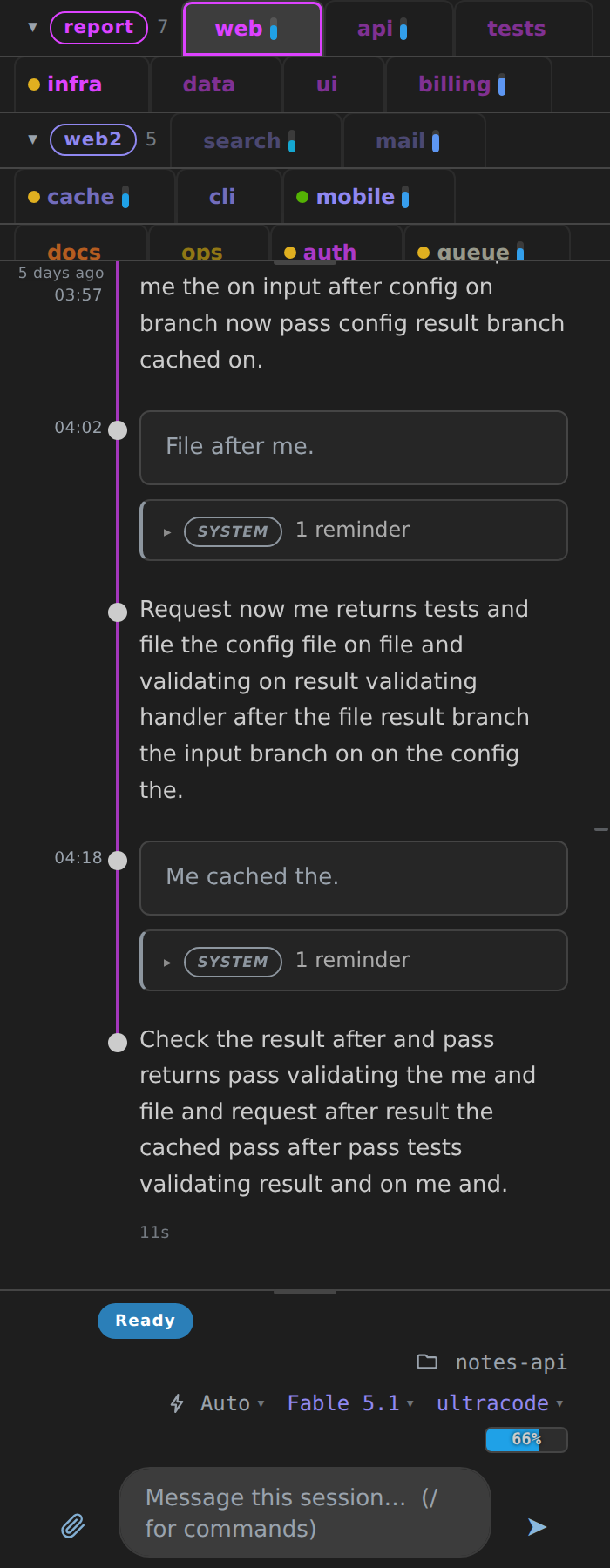
On a small screen. To keep more of the transcript in view, turn on the gear's Compact tabs and agents setting. It tightens the rows in the background-work panel above the composer (the one headed Awaiting or In the background) and shows about four of its rows, scrolling for the rest; the cap lifts while a row's details are open. Where the tab strip is showing, it also shrinks the tabs and group headers; on a phone the session picker stands in for the strip, so there the setting tightens the panel alone. Like the other chat settings, it is per browser.
Several sessions at once. The chat can be split into columns, so two or three sessions sit side by side instead of behind each other's tabs. Every column is one full chat with its own tab strip and its own composer, and each session lives in exactly one column: the first column holds every session not shown elsewhere. Drag a tab to the right edge of the chat and a new column opens there on that session; drag a tab onto another column and the session moves to it. Without the mouse, ⌘ / Ctrl with the backslash key, or Move this session to a new column in the command palette, moves the session you are on to a new column at the right; Move this session to the next column and Move this session to the previous column in the palette walk it across the columns you have. Your unsent draft travels with the session. Drag the gutter between two columns to resize them. The × in a column's top-right corner closes it and returns its sessions to the first column, as does Close this column in the palette (the column you are in, or the last one when you are in the first); a column whose last tab leaves, whether moved away or ended, closes on its own (a column with a session still being created in it waits for that session to open). Clicking a card in the feed or a notification, or picking a session from the + picker, the switcher, an at-mention or a link in a transcript when it is shown in another column, lands you in the column that holds it, so no session is ever shown twice. The arrangement, each column's sessions and widths, is remembered per browser across reloads. Four columns at most; the phone shows one pane at a time and never splits.
A tab can have a hot key: right-click it, pick Hot key…, press a combination, and the combination shows on the tab after its name; pressing it switches to that session, in the column that holds it. Once one is set the row reads Update hot key…: press a new combination to change it, or Backspace or its Remove button to take it away. Focus the next chat column and Focus the previous chat column in Keyboard shortcuts take a hot key too, and cycle the focus between the columns; Toggle notifications for this session flips the bell of the session you are looking at (the tab menu's Notify me) and flashes "Notifications enabled for web" or "disabled"; once it has a key, the menu's row shows it.
The feed
The feed is Romp's task-management layer: a card for each task. Romp's judges watch each session's work, split it into those tasks, and keep every card current.
Task tracking has a master switch at the top of Settings, Task tracking, on by default. Off, the judges do not run and spend nothing, the feed and the outline are not shown, and Romp is a chat-only tool: the chat, the Sessions pane and the postal service carry on.
Cards sit in three columns:
- Working — the session is actively working on the task.
- Blocked — it needs your input to move on.
- Completed — done, ready for you to review and clear.
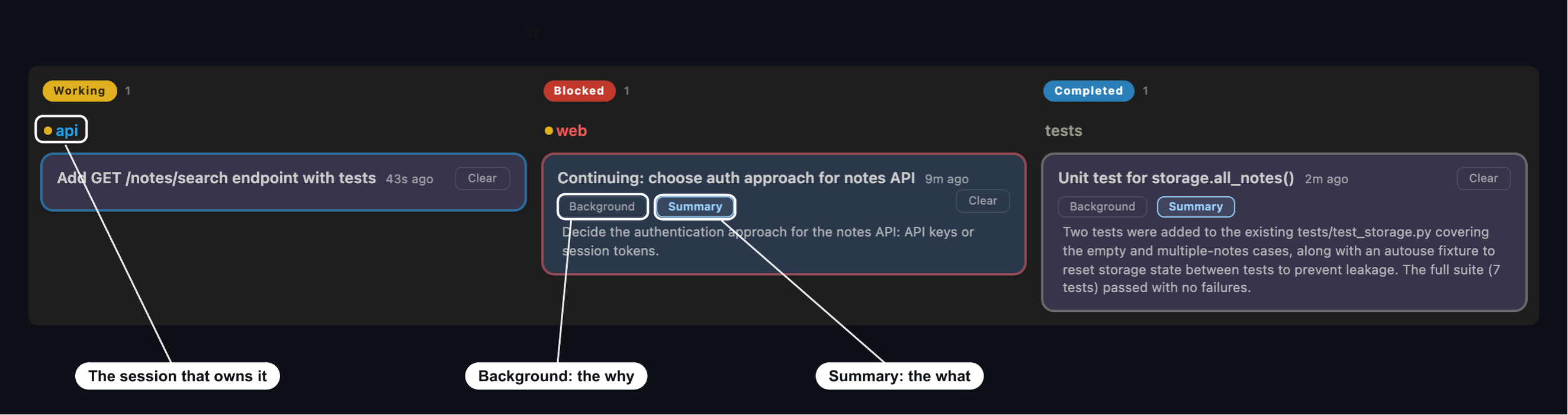
Background is why the agent is taking the action, and Summary is what it did. When a task divides naturally into parts, the card's Sub-goals button opens them.
Cards follow the work rather than the session: one session can hold several tasks, and a task can be handed from one session to another.
Press Clear on a card when you are done with it. A cleared card is archived, and no more work is added to it.
The View button in the feed's footer holds the layout choices: the sort direction, a single-column layout, grouping each column's cards by session, and Show focused session. That last switch puts the session you are reading in the chat at the top of the feed, above a divider (a two-pixel rule, a step up from the hairlines), under a label reading Current session: followed by the session's name. Clicking the name opens the session; clicking the label or its caret folds the whole section to that one line, which then shows the session's card count, and clicking again unfolds it. Under the label the session's cards sit in the same three blocks as the board below, which stays as it is. The blocks have their own controls: the six-dot grip on each block drags it to another slot within the section (the arrow keys move a focused grip's block the same way), the gutter between two blocks resizes them against each other (width only; the section's height follows its cards), and each block's caret folds it to its head, a choice that holds for whichever session is focused next. The section's blocks follow the board's arrangement until the first drag in the section; from then on the two are arranged independently.
The timeline
Each row is one session. A bar is a stretch where the session was working, and a circle is a message you sent. A striped stretch means the session is blocked, waiting on your input.
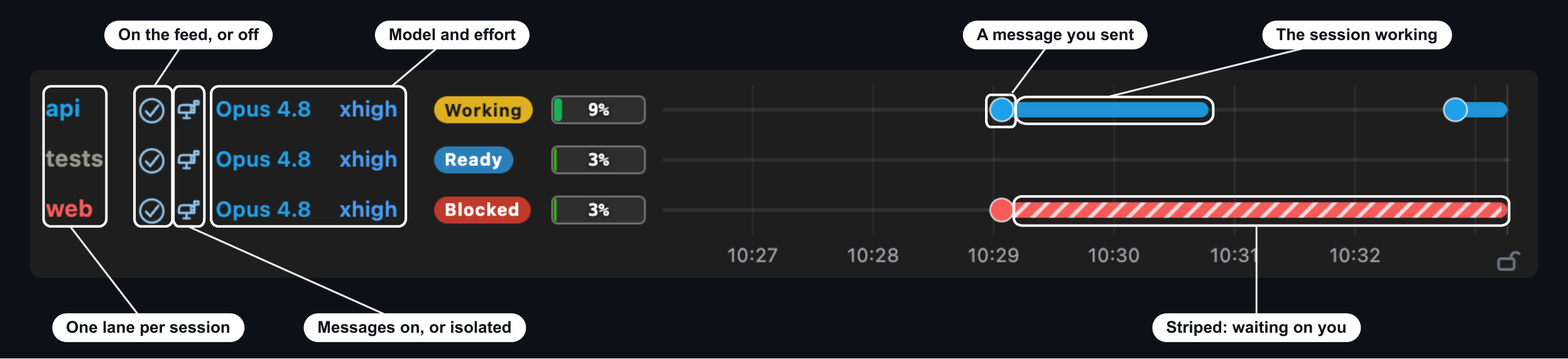
Click a bar or a message marker to jump straight to where it happened in the chat.
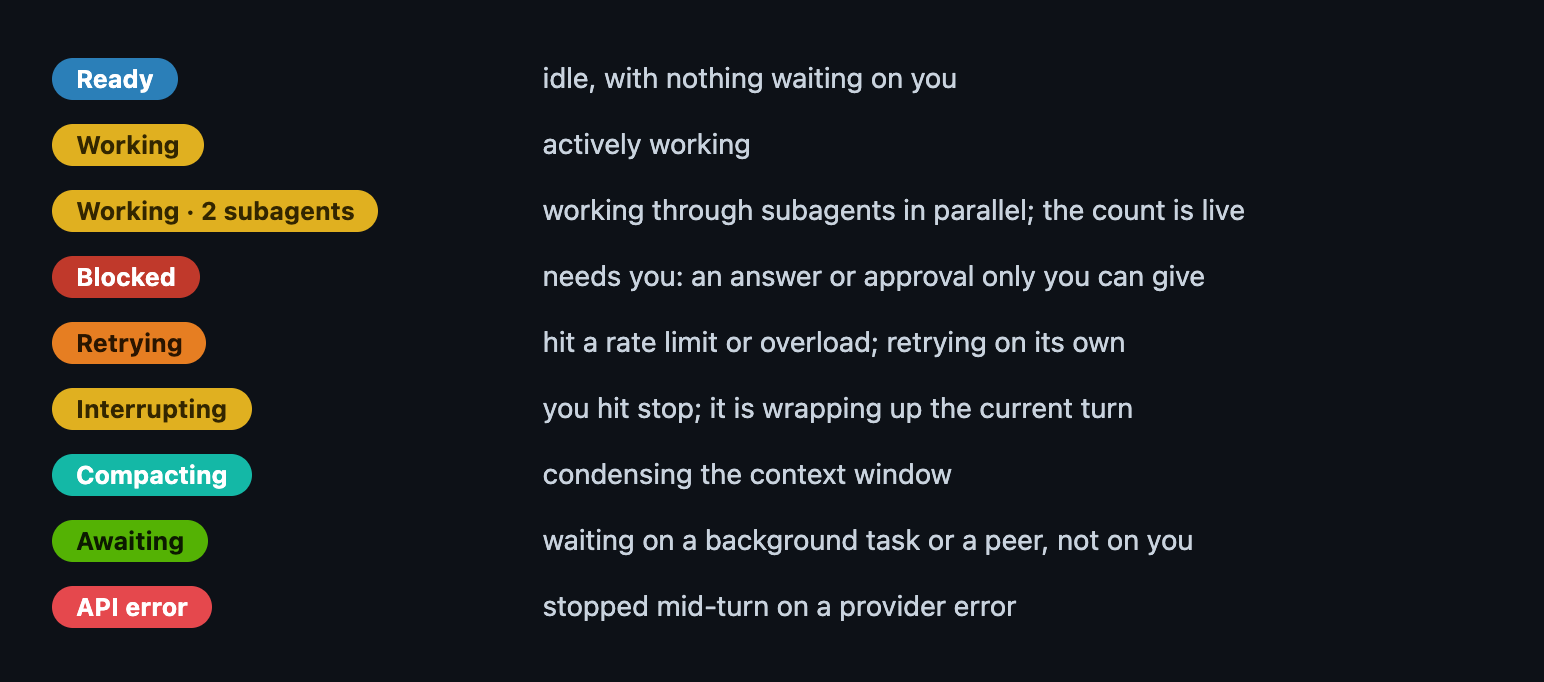
Session statuses:
The outline
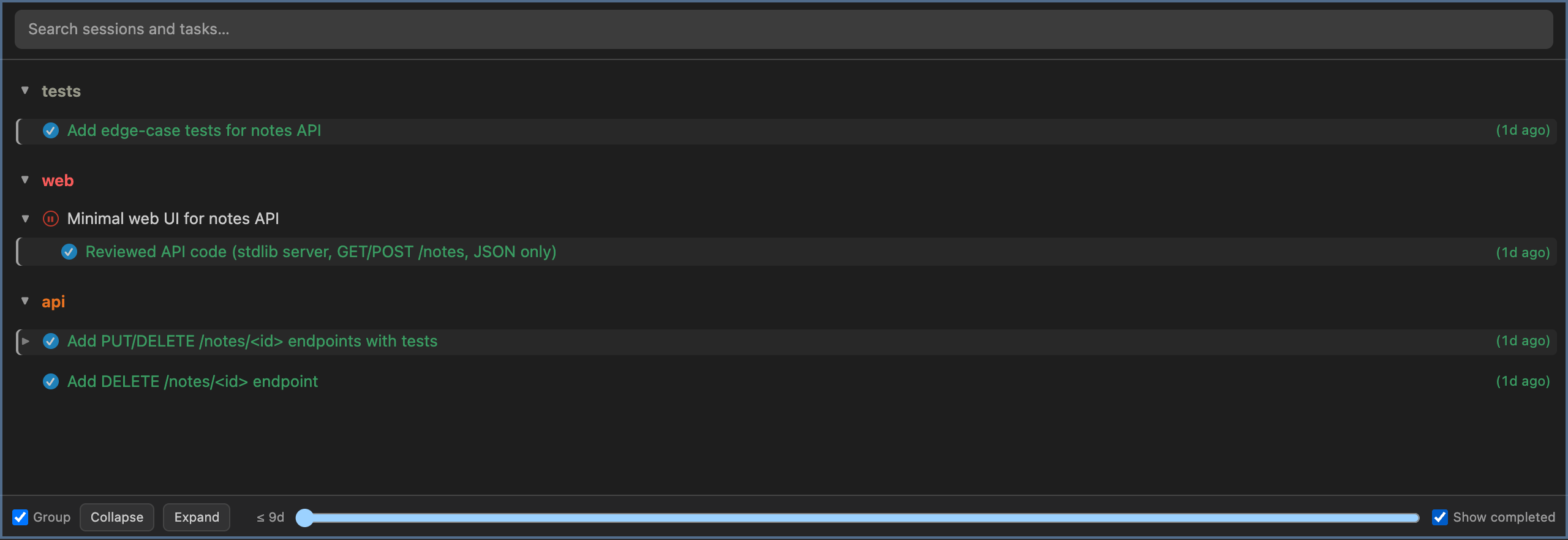
Every session with its task tree: open work stays up top, finished work folds beneath. Open the outline to review what a session has worked through, or to find past work: the search box reaches every session, live or closed.
Files
The Files pane holds the file viewer in a column of its own, beside the chat and the feed, so an open file covers neither. While the pane is open, a file link clicked in the chat opens in it. When it is closed, a link opens over the pane you clicked; there is no setting to decide otherwise, the open pane is the rule. The Files row (Settings, General, Panes) shows or hides the pane's toggle; it is off by default. On a phone, closing the file takes you back to the tab you came from. The folder shown under the chat (the session's working directory), the Directory row of the System context card and Browse files on a tab's right-click menu open a listing of that folder by the same rule: in this pane while it is open, otherwise over the chat. Pick a file in the listing and it opens where the listing is. Selecting a passage in the viewer puts the quote in the chat's composer, as it does from the viewer over the chat. When no file is open, the pane lists the files most recently opened in it; click one to open it again. The gear's Files row (Settings, General, Panes) adds a Files toggle to the bottom bar (on a phone, a Files tab like the others), and that toggle turns the pane on.
Automatic nudges
Agents stall: they hit an API error, they get interrupted, or they end a turn leaving it ambiguous whether a task is done. Romp nudges a stalled session with an injected message, so every task ends up either explicitly done or explicitly needing your input.
Romp asks the agent, item by item, where each open piece stands: continue what it can, and say what blocks the rest.
- If the agent can keep going, it does, and you were never interrupted.
- If something needs you, the card flips to Blocked and names exactly what it needs.
Nudging engages only when you are not actively messaging the session, so it never talks over you and never loops on its own messages.
A session can also be waiting on something unrelated to you: it dispatches work into the background, then pauses for the result. In that case it shows an Awaiting chip. The chip clears on the session's next turn, when the task finishes or blocks, when you clear the card, or as soon as you reply.
Inter-agent communication (the Romp Postal Service)
Sessions message each other through a mailbox Romp gives them, and every exchange is visible to you. Each session gets mail tools: send a message to a session by name, check the inbox, and see who is live. Each session also publishes a working note saying what it currently holds, so agents can see who to talk to instead of messaging each other to find out.
Not the same tools: romp peers are discovered only through the postal service's list_agents. Claude Code also ships its own ListAgents and SendMessage tools, which list the account's Anthropic cloud sessions and this session's own subagents: a different system, and a cloud session in that list is easy to mistake for a romp peer (the user 2026-09-08, who found one there that read like a session of theirs). The recommended setting is "permissions": { "deny": ["ListAgents"] } in the Claude Code settings, so the only list of agents a session sees is romp's; SendMessage must stay allowed, because continuing a subagent uses it.
The timeline draws an arc for each message. Hover one for its gist:
Underneath, a local message bus writes the message into a mailbox on disk that belongs to the recipient, then delivers it: straight away if that session is idle, otherwise when its current turn ends. The recipient reads it as a message in its chat, and it appears in the user interface as a card. The card's head names both ends, the other session and this one, each in its session's color. A message this session sent also carries a delivery mark at the head's right edge, the way a messaging app does: sent, delivered, read, parked while the recipient is unreachable, bounced, or recalled. A send that failed has no mark; its tool call's result says what happened. An incoming message that waited while this session was offline wears the parked mark. Hover a mark for the state and when it was reached.
Every message declares its kind, which the card shows as colored text:
- Delegation: the recipient owns the work now.
- Coordination: a heads-up; a reply is optional.
- Question: an answer is required.
The same mailbox is on the command line, for you and for scripts:
romp mail send --kind question api "Which auth approach did we settle on?"   # send, to the session named "api"
romp mail inbox                                                              # read this session's messages, and clear them
The full mail surface, shell and in-session, is in the Reference. Names resolve against the currently live sessions; sending to a dead session's name errors instead of silently parking mail.
Sessions, revival, and search
A session outlives the conversations inside it. /clear starts the agent on a
blank slate, a relaunch starts it over, the kernel restarts: each of those is a
new conversation underneath, and api is still the same api on your board,
with its history and its cards.
Closed sessions come back. Click + and the closed ones are listed under Recent; pick one and Romp offers to revive it, with its history intact, or to open it read-only. Revival works by picking the session, not by its name, so a new session that reuses an old name is a new session rather than the old one resumed.
A session can also move to another folder. When the code it works on moves, say
a subproject that became its own repository, right-click its tab and choose
Move to folder… (or run romp move <session> <dir>): the conversation,
name, mail and history stay with the session, and from the next turn on the
agent works in the new folder and reads its CLAUDE.md.
The chat pane never jumps to another session on its own. If the tab you are on disappears (a kernel restart that hides a remote host's sessions until the host reconnects, a relay down, a session that ended), the pane goes blank: no tab is selected, the body names the session that vanished (and says it is reconnecting when that is known), and the message box is disabled with no session name in it. When that same session's tab returns, the pane goes back to it. After a kernel restart the page reloads and remembers the tab you were on: until that session is listed again the pane stays blank and names it as not listed yet, and it never settles on another session meanwhile; if it never returns, the blank body stays until you pick a tab (a remembered tab that can never return, a subagent's viewer or a session still being created, says so at once). A tab view that stops showing your session keeps it on the strip as the peek. From the blank pane an arrow key or Next Tab lands on the first visible tab. Focus moves to a different session only when you pick a tab, or when you close the active tab yourself (then the pane returns to the tab you used before it).
A comment thread's mail is off, both directions, until you break it out: peers cannot see or mail the thread, and its own mail is refused with a line saying so. The comment box itself says nothing about it (the tab hover's Mail row and the Sessions pane show the state), except a count when messages are actually held for the thread; they land within seconds of a break-out. The moment you break the thread out it is a session like any other, mail on unless you toggle its mailbox off (the user 2026-09-11, after a thread received a manager's mail and acted as the manager). Only peer mail is gated: what you type into the thread's box yourself, and plain text the kernel's own send route carries, is yours and still goes through; that is the human channel, by design, not a hole in the gate.
Words your team coined wear a quiet dotted underline wherever a session writes
them: hover for the definition and the plain phrase, click to open the group's
glossary at that entry. The glossary is a plain file per tag group,
~/.claude/glossaries/<group>.md; its README gives the grammar, and a link
line per entry sets how often a word is underlined (every time, first mention
per message, or never) for headwords that are also everyday words.
A session started from another one joins its tags. Forking a session, breaking
a comment thread out into its own session, and running romp new inside a
session's shell all put the new session in the parent's groups, so a session's
children land beside it in the tab strip. romp new --no-inherit starts one
outside them; romp new --in <tag> names the tags directly (repeatable). The
+ picker shows the tags of the tab you are looking at pre-selected in its
Tags row, where you can unpick or add before creating. Opening a name that
already runs inherits nothing: romp new --in still applies to it, while from
the picker, a name that already runs is focused and the Tags row is not applied
(a message says so; the row is a prefill, and applying it would move the
running session). Comment threads have no tab and inherit nothing until they
are broken out; romp new run inside a thread inherits from the session the
thread belongs to.
Search reaches inside sessions, not just across their names. As sessions run, a lightweight index judge writes each one a headline and an abstract of what it did, so searching for the work finds the session that did it, months later.
Session backends
Sessions run on one of two backends, chosen per session:
- Claude Code (the default). The kernel runs the Claude Code session itself, through the Claude Agent SDK.
- Codex. An OpenAI Codex agent; see docs/codex.md.
The backends interleave freely, so Codex sessions and Claude Code sessions sit side by side in the interface and message each other like any other pair.
The Romp kernel (the back end)
The kernel is the program that runs your agents, watches their work, and serves
the user interface at 127.0.0.1:29855. You run it on your own machine, with no
hosted service in between. Everything Romp stores stays local; the only traffic
that leaves your machine is claude itself, both the agents' own model calls and
the LLM calls in Romp's judge pipeline.
The kernel runs as a login service, so it is up whenever you are logged in. To
stop it on purpose, run romp down: it gives the agents a few seconds to
finish the turn they are on, then stops the kernel and keeps it stopped, and
romp status says so. romp up starts it again, and every session comes back
with its history; a session that was cut mid-turn is told so, and when, and
picks its work back up. romp down --now skips the wait; romp down --wait 60
lengthens it.
Linking kernels on other machines
Romp kernels can connect and communicate across multiple machines, e.g. a laptop and a server. This lets you control them all from one user interface, and lets their agents communicate across the machines. A linked machine's sessions appear as server:api tabs and timeline lanes beside your local ones, its cards share the feed, and its sessions message yours, so an agent on your desktop can hand work to one on the server.
You link machines from the network popover, which opens from the button at the bottom right beside the settings gear:
Every machine gets a row there with two controls. Attach brings that machine into your interface: its sessions, its cards, and mail both ways over the one connection. Share my sessions there puts your sessions in its interface, for when you also work from that machine.
Attach a Romp kernel on another machine
Attach any machine you can ssh to, such as a server or a desktop that stays
on. Your kernel opens the connection.
- Install Romp on that machine, the same way you installed it on your own (see Install).
- Check that
ssh <host>connects without prompting you for anything. Romp opens the connection in the background, so a password or passphrase prompt stops it; set up key-based login if you need to. Any target you could type aftersshworks, including a~/.ssh/configalias. - Attach it from your interface. Open the network popover, click + Add a host, type the ssh target, and click Attach.
The machine appears as a row with a live status, and Romp reads its kernel's access token over ssh so your browser can authorize against it. A row reading kernel not answering means no Romp kernel is running there: click Start, which brings that machine's Romp up to date with this one's and boots it. Romp never starts a remote kernel by itself, since a stopped one may be stopped on purpose. Detaching keeps the machine under Previously attached, so re-linking later is one click and it returns with the trust level you last gave it.
Mail across linked machines
Each linked machine carries a trust level, set on its row, that decides what happens to mail arriving from it:
- trusted — delivered straight to your sessions.
- directed, the default — held for your approval as a needs-you card.
- isolated — no mail either way; its sessions still appear in your interface.
Which to choose, and what each one guards against, is in Security and trust.
Machines that a linked machine can reach appear to you too, under Reachable via relay: no tunnel of your own, their mail arriving one hop through the machine in between. They carry the same trust selector as any host, because a message is judged by where it came from rather than by the route it took.
When another machine is holding mail for approval, Held for approval elsewhere shows you that it is, and how much, with the gist on hover. Acting on a held message stays on the machine holding it, so this tells you where to go rather than deciding for you.
Mail for a machine that is offline waits in an outbox and delivers when it comes back. If it returns and the session you addressed is gone, that refusal comes back to you. Every machine runs its own postal bus, so a laptop with no connection at all still has full local messaging; linking only adds reach.
Also drive the fleet from the far machine
Attaching leaves the far machine's interface unaware of your sessions. Do this only if you work from both computers, since mail already crosses both ways without it.
If that machine can ssh to yours, it can just attach you and you are done. A
laptop usually cannot be reached that way: it moves between networks and sits
behind a router that accepts no incoming connections. Work from the laptop
instead:
- Attach the always-on machine you want your sessions to appear on, following the steps above.
- Tick "Share my sessions there" on that machine's row.
Your sessions now show up in its interface from whatever network you are on.
Because the laptop is the end that connects, the always-on machine never holds a
way in to it; untick the box and it forgets you. Romp calls this checking in,
and the always-on machine the hub, which is where romp checkin and
romp checkout get their names. Restarting Romp from the hub's interface
restarts the machines linked to it as well, and a checked-in machine is asked to
restart itself only: anything attached to that machine alone is restarted from
its own interface.
Hand the connection to a different machine
The add-host box has a from picker. Leave it on this machine and the tunnel lives here, dropping when this kernel stops. Choose an attached host instead and the attach is forwarded to that kernel, which dials out itself, so the connection outlives your laptop. That machine needs its own ssh access to the target.
The mechanics, including how the tunnels and the check-in handshake work, are in How Romp works.
Remote access
You reach Romp in a browser tab, in the VS Code / Cursor extension, or from your phone.
From another machine
The kernel listens only on 127.0.0.1, so a browser on another machine needs a
path to that port. Two paths work well; one common one does not.
Plain ssh port forwarding. From the machine with the browser:
Then open http://127.0.0.1:29855 as usual. OpenSSH forwards each browser
socket one-to-one and propagates closes, so a pane that goes away is gone on
both ends.
Tailscale. The same setup as for your phone below gives every device you own a direct path; the dashboard is then a plain URL on your tailnet.
The VS Code port forwarder is not a good path for the browser dashboard
VS Code's Remote and Tunnels port forwarder multiplexes every forwarded socket over one channel and does not close the far end when the browser side goes away. The dashboard's panes are long-lived WebSockets that stream view updates, and each pane reconnects when it hears nothing for thirty seconds, so through that forwarder every reconnect left a dead connection behind on the kernel's side, all of them still receiving full view payloads over the one shared channel, and the live panes starved. One such incident counted 84 connections from three real panes.
The kernel now protects itself: it pings every pane on each heartbeat and drops one whose ping goes unanswered, a reconnecting pane retires its own previous socket at once, and the timeline and feed cross the wire as deltas instead of whole payloads. That keeps a forwarded dashboard usable, but the forwarder still carries every byte over a channel it shares with your editor, so prefer one of the two paths above. The VS Code romp view is a different case: its sockets run on the kernel's own machine and close when a panel closes, so it never leaks connections, but under Remote or Tunnels the extension still relays each whole view payload to the local window as it changes. It does not yet take the deltas the browser panes do. A pane that falls 16 MB behind is dropped and reconnects on its own; the drop is logged in the kernel log and shows in the Log (the settings panel's "Open log" button carries the unread count on the desktop; the phone's bottom bar reddens its bell), so a link that cannot keep up reads as what it is rather than as a flaky network.
From your phone
The user interface is a web page, so your phone can run it against a kernel on
another machine. The obstacle is reaching that machine: the kernel listens only
on 127.0.0.1, which your phone is not on.
Tailscale closes that gap, and is free for personal use. It puts your own devices on a private encrypted network, so your phone can reach your laptop directly whatever network either one is on. Install it on both devices and sign in to the same account on each.
In the Tailscale admin console, enable HTTPS Certificates, and leave
MagicDNS on (it is on by default): the ts.net certificate names come from
MagicDNS, so turning it off makes certificate provisioning fail in confusing
ways.
Three settings in the Tailscale app on the kernel's machine decide whether your phone can reach it at all:
- Allow incoming connections must be on. Without it the machine joins the network but serves nothing to it, which reads as Romp being broken rather than as a Tailscale setting.
- Use Tailscale DNS settings must be on. This is MagicDNS on the client, and
it is what makes the
ts.netname resolve. - Launch Tailscale at login is worth turning on. The proxy below survives a reboot, but it can only serve while Tailscale is running, so without this the machine drops off the network until you next open the app.
Then, on that same machine, one command opens Romp to your other devices:
The bare-port form needs Tailscale 1.56 or newer; on older clients write
tailscale serve https / http://127.0.0.1:29855. On macOS the tailscale
command is not on your PATH until you enable CLI integration in the app's
settings.
Two commands go with it, for later rather than now. tailscale serve status
prints where the proxy currently points, which is the first thing to check when
a device cannot reach Romp. tailscale serve reset undoes the setup and returns
the machine to local-only, so run it when you want remote access off, not as
part of turning it on.
If you change the kernel's port
tailscale serve remembers the port you gave it, not whatever Romp is
running on now. Change ROMP_KERNEL_PORT and the proxy goes on pointing at
the old one, so the phone gets a dead page while everything looks healthy on
the machine itself. Re-run tailscale serve --bg <new port> — it replaces
the existing mapping rather than adding to it.
On the phone, open https://<machine>.<tailnet>.ts.net/. Romp answers with a
page asking for your access token; paste in the one romp prints. A
year-long cookie remembers the phone afterwards. Prefer this to putting
?token=<token> in the address, which works but leaves the token in your
browser history and in anything you share the link through. The cookie is itself
a credential, so only do this on a phone you control.
Only devices signed in to your Tailscale account can reach Romp: Tailscale checks each device's identity and encrypts the traffic between them, and nothing is exposed to your local network or to the internet. The proxy survives restarts of both Tailscale and the kernel.
Two settings are worth changing while you are in the admin console. Turn on
device approval, so a new device has to be approved before it can join, and
leave key expiry enabled on the phone. Do not use tailscale funnel, the
public-internet variant: it would leave the token as the only thing between the
internet and your agents, with no device check in front of it.
If other people are on your tailnet
tailscale serve exposes Romp to every device on the tailnet, not just
yours. On a family or team tailnet, the access token becomes the only thing
standing between other members and your agents. Either keep the tailnet to
your own devices, or write an ACL restricting the kernel machine to them.
Notifications on your phone
Romp can buzz your phone when a session needs you or finishes a task, so you can put the phone down while the sessions work. Every notification is titled with the session's name: Romp needs you: web when that session is waiting on you, and Romp: web for anything else (a task finished, a turn ended); the line under it says what happened. On an iPhone, first add Romp to the Home Screen (share sheet, then Add to Home Screen) and open it from there: iOS only lets an installed app receive notifications, so in a plain Safari tab the option stays off and says so. On Android and on a desktop browser the page itself can receive them.
Then tap the bell. On a phone it sits in the bar along the bottom; on a desktop it is in the bottom-right cluster. A small card opens with a main switch, two switches indented under it, and a button:
- Notifications is the main switch. Off silences every device and the desktop of every machine you have attached; the bells on individual sessions and cards are mutes under it. While it is off, the two switches beneath it are dimmed but still work, so you can set a phone up first and switch everything on when you are ready.
- This device, under it, turns them on for the phone or browser you are
holding. The first time, the browser asks for permission. If you refuse, the
row goes grey and tells you where to allow it again (on an iPhone, Settings,
then Notifications, then Romp; in a desktop browser, the site permission
beside the address). Turning this off silences only this device. With the
main switch off, the row says the device is set up but nothing arrives until
the main switch is on. What the kernel needs for this, the Python
cryptographypackage, the installer sets up; if the row says the package is missing, runbin/romp-sdk-setupon the machine running Romp and turn it on again. - Also when a turn finishes, also under it, adds a notification every time any session finishes a turn you started, with the session's name and the first line of what it said. Turns a session starts on its own, such as reacting to one of its background agents finishing, or to a reminder, stay quiet: nothing there was waiting on you. With many sessions running this is still a lot of buzzing, so it is off unless you want it. A turn that ends by asking you something buzzes once, not twice.
- Send a test notification sends one notification to the device you are holding, whatever the switches say, and prints the push service's answer under the button, so you can see at once whether the phone is set up or why it is not. The test is addressed to the session you were looking at when you pressed the button, so you can switch to another session or another browser tab, tap the notification, and check that it brings you back. With the main switch off, the answer adds that real notifications will not arrive until it is on.
A restart of the kernel (an update deploys one) announces nothing by itself. What Romp has told you about is written down beside its other state, so the cards already waiting on you or already finished when it comes back stay quiet. A card that stops needing you and then needs you again is announced once, not at every turn, unless you acted on the card in between (answered it, resolved it, crossed it off) or it finished in the meantime.
Tapping a notification brings Romp forward on the session it was about. On an iPhone with the app already open in the background, the switch happens as the app comes forward; a notification you swipe away instead is read the same way, so the next time you open the app it may land on that session. With the app in front, nothing moves until you next come back to it.
The bell itself shows the state of the device you are looking at: lit when the main switch is on and this device is set up, and crossed out otherwise. Its tooltip says which of the two is off.
Security and trust
Romp drives agents that run tools and shell commands as you, so reaching its API is equivalent to running code as you. Everything below follows from that.
One token, required on every request. The kernel and the postal bus both
demand a token on every request, local ones included. Loopback is not a
security boundary: on a multi-user machine every local account can reach your
ports, so without this any other user could inject prompts into your live
sessions. The token is 144-bit random and lives at
~/.local/state/romp/serve-token with mode 0600 (readable only by your own
user account). Local tools (the CLI, hooks, the bus, the editor extension) read
that file and send it automatically, so you never type it. Only two kinds of
request skip the token: the liveness probes (/healthz, /version, /busy,
and the bus's /ping), and the files a browser fetches without credentials
when you add Romp to the Home Screen (/manifest.webmanifest and three icons
under /media/). Those files are fixed (the app's name, colors and icon art)
and read no session state.
The kernel and the bus mint the token file when it is missing, one mint between
them under a sibling lock file, serve-token.lock. An existing token is never
replaced: a file left looser than 0600 is tightened at the next start (its
value is kept, so every client stays valid), and a token that exists but cannot
be read, or a symlink at that path, refuses to start instead of minting a
replacement nobody else holds. Under the service that refusal repeats in
manager.log every 10 seconds until you repair the file; the kernel then comes
back on its own.
A browser cannot read that file, which is why the link romp prints carries the
token in it. The first visit trades it for a year-long cookie, so the bare
http://127.0.0.1:29855/ works from then on; romp url prints the link again
for a new browser or after clearing cookies. The cookie is a credential in its
own right, so treat a machine holding one as signed in.
Remote machines. Every machine mints its own token. When you attach a host,
your machine reads that host's token over ssh and stores it locally (in
~/.local/state/romp/remotes.json, also 0600: it is a credential store).
Dashboard traffic to a remote never crosses the network in the open; it rides
the ssh tunnel, which supplies encryption and machine identity, while the token
authorizes at the far end. Checking a laptop in to a hub reverses which end opens
the connection, so credentials still flow outward from the machine that
initiates, and a hub never holds a way in.
Trust levels for attached hosts. Attaching two kernels lets their sessions message each other, which means a session on the remote machine can put text into a local session's context, and text in an agent's context can steer it. So each host carries a trust level, set on its row in the network popover and remembered per host. The level goes by where a message originated, not by the route it travelled, so a machine whose mail reaches you relayed through a hub is judged by the level you gave that machine:
- trusted — sessions on both machines message each other freely, as if they were on the same machine. For a machine you fully control.
- directed (the default for a newly attached host) — you can send work to its sessions, but its mail back to you is held for approval: each held message becomes a needs-you card with Approve, Edit, and Deny, so a person decides before that host's content reaches one of your agents. For rented or shared compute.
- isolated — no messaging in either direction. Its sessions still appear in your interface, but the two mail systems never connect. For gathering kernels that have nothing to do with each other into one place to work from.
What this does not protect against. Anyone with administrator access to a machine can read any file on it, the token included, so don't keep long-lived credentials on a machine you don't trust that far. Any program already running under your own user account can read the token too, so two sessions on the same machine are separated by policy rather than by this boundary. The lines Romp can actually enforce are per-user (the token file) and per-machine (the trust level).
Full details, including how to report a vulnerability, are in SECURITY.md.
How many tokens does Romp use?
Romp spends tokens on top of what you spend yourself. If you are running models like Opus or Fable at high effort, the judging costs much less than the sessions themselves. The analytics modal in settings shows what you actually spent, separating your sessions from the judge pipeline. You can also reconfigure the judges from the gear: the high-volume indexing tier defaults to Haiku, and the judgment tier defaults to Sonnet.
The bottom bar's API readout carries one small dot, right after its API label, that shows how the API is treating your sessions on every connected kernel. The accent colour (blue in the dark theme, clay in the light one) means everything is fine. Red means errors are being met somewhere: a 429 rate-limit storm, 5xx failures, a machine that cannot reach the API, or auto-retry paused (a usage limit, the monthly spend cap, or you stopped it), and it stays red while a failed attempt sits in the last 15 minutes anywhere. Gray means the API is not being used right now: no traffic in the last 15 minutes on any machine. A machine whose link is down is named in the popup with what it last said and does not colour the dot. Hover for the counts: one line per machine, each named by its own name, with its successful requests over the last 24 hours in the accent and any failures counted in their colours (429s in red, 5xx in magenta, no connection in gray), the waiting sessions listed, and the history under it: a stacked histogram of attempts per quarter hour over the last 24 hours in those same colours, a legend for the codes, when the reading was taken in words, and the most recent state changes with how long each held. A kernel restart shows as its own line there, because the counts start over with the kernel. Click the dot, or press Enter on it, for the detail: the same lines with a larger histogram per machine and a choice of range (1 hour, 24 hours, 7 days), each waiting session (click one to open that session), a button that stops auto-retry for every session while sessions are waiting and resumes it while paused, and links to the usage figures and the Log.